Tuote lisätty ostoskoriin

Online child sexual harassment and abuse are among the most serious problems of our time. In Finland, one in five children has experienced sexual violence.
Sexual violence against children includes all acts that violate a child’s sexual integrity and right to self-determination.
According to our report every third girl in Finland has experienced sexual violence. Of all children, every fifth has encountered sexual violence.
Our work speeds up the removal of child sexual material (CSAM) from the internet and prevents children and young people from becoming victims of sexual violence.

Report sexual harassment against a child, grooming or sexual violence online or images/videos depicting sexual violence against a child to our Nettivihje service.
Don’t hesitate to report. You don’t need to be sure that a crime has been committed.
By reporting you protect children.
The term “child sexual abuse” covers any and all acts that violate the sexual integrity and self-determination of a child. Child sexual abuse also serves as a generic term for sexual harassment and grooming. By “child”, we mean anyone under the age of 18.
“Sexual abuse” refers to any act or attempted act that harms another person sexually, any unwanted sexual comment or advance that takes place without the consent of the other person, regardless of the relationship between these persons. Sexual abuse is a form of violence where the boundaries of another person are violated by, for example, touching, harassing or coercing them. Sexual abuse can take place in any setting, such as in the home, in a public space or online.
Examples of child sexual abuse:
Every child has the right to be protected from all forms of violence. Child sexual abuse involves an adult or a person clearly older than the child using the child to satisfy their own sexual needs. Sexual abuse is the abuse of power. A child is never to blame for the sexual abuse they have experienced.
Sexual abuse can have a wide range of effects on the child and their development. It is therefore important that the child receives support and help from professionals to deal with what has happened. A child or a person who has been a victim of sexual abuse as a child should not be left alone to cope with their experiences.
Child sexual abuse is a criminal offence and must be addressed. This ensures that the child will receive help. The Criminal Code of Finland (39/1889) includes different terms and age limits for different forms of sexual abuse. If you suspect that a child has been a victim of sexual abuse, you should always report it to the police and child welfare services. You don’t have to be absolutely sure, and as a normal person, you don’t have to know the Criminal Code of Finland in detail. You can also ask the police and child welfare services for advice.
Please note: Professionals have a duty to notify the police and child welfare services if they suspect that a child has been a victim of sexual abuse.
Every time a photo or video depicting child sexual abuse is shared or viewed, the child once again becomes a victim and their rights are violated yet again. Sexual abuse and the distribution of materials demonstrating it can have serious mental consequences for the child at the time of the offence, later in childhood and for the rest of their life. A violent experience in childhood needs to be properly processed.
Child sexual abuse material (CSAM) is evidence of a sexual crime commmitted against a child regardless of the child’s age, sex, or other similar factor. By “child”, we mean anyone under the age of 18. Materiaalista käytetään Suomessa ja kansainvälisesti usein termiä ”lapsiporno”, vaikka tämä on harhaanjohtava ja ilmiötä vääristävä. Suomen rikoslaissa käytetään termejä “lasta seksuaalisesti esittävä kuva” ja “lasta seksuaalisesti esittävä esitys“. Materiaali todistaa kuitenkin lapseen kohdistunutta tai kohdistuvaa vakavaa seksuaalirikosta.
Intentional recording and distribution of images of sexual abuse often plays a central role in a sex offence against a child. A sex offence against a child and recording of such an offence in the form of any images are often committed by people close to the child in a home-like environment. The offence may also be committed entirely on the web.
Typically, the term CSAM refers to one of the following:
People who use CSAM to satisfy their own sexual needs do not always realise or acknowledge the link between use of the CSAM and an actual sex offence. However, demand for illegal CSAM increases the need to produce such materials – either for personal use or for others. In practice, this means more sex offences against children. It is impossible to accurately estimate the amount of illegal CSAM in the world, as much of the offences go unnoticed by the authorities.
The production, possession and distribution of CSAM is illegal in Finland (Criminal Code of Finland 39/1889, chapter 20). The law defines a child as a person under the age of 18. A person distributing sensitive images, information or claims may also be guilty of the dissemination of information violating personal privacy or defamation.
The term “grooming” refers to persuading a child to a sexual act. The aim of grooming is to abuse the child sexually.
In grooming, the adult’s goal is to lure the child into a situation where they can be subjected to child sexual abuse, either online, in real life or in both environments. Grooming is a multidimensional phenomenon that includes any and all words and actions that the groomer directs towards the child or a person close to the child.
Grooming can also be a very quick process
Grooming can be very fast-paced communication, where the groomer tries to get the child to act spontaneously. In some cases, it may be just a single contact with a child or an attempt to contact a child. Grooming can also be a slow-moving process, however. For example, a groomer may establish a trusting relationship with the child and gradually infiltrate sexually explicit content into everyday conversations.
If someone tries to groom a child, they may:
The perpetrator is always responsible
Grooming takes place both online and in real life. Online, the perpetrator may be simultaneously in contact with several children, and it is easy for them to be anonymous or use a fake profile. The perpetrator may lie about details such as their age and gender. The perpetrator may also reveal that they are an adult and offer the child friendship, admiration, gifts or guidance on sexual matters, for example. Grooming can take place on any online or social media platform where children spend time.
It may be difficult to recognize grooming
It may be difficult for a child to recognise grooming or sexual abuse inflicted on them as the result of grooming. Grooming can lead to, for example, the adult getting the child to send nude photos or videos of themselves. The child may also be proactive or active in the communication. All of this can make the child feel guilty and ashamed. However, a child is never the guilty party when they have been subjected to grooming or sexual abuse.
Grooming is a crime!
Solicitation of a person under the age of 18 for sexual purposes is illegal in Finland (Criminal Code of Finland 39/1889, chapter 20, section 18). If you suspect the grooming of a child, you should report it directly to the police or to the Finnish Hotline.
“Sexual harassment” refers to verbal, non-verbal or physical unwanted conduct of a sexual nature that violates the mental or physical integrity of another person.
The term somewhat overlaps with the term “sexual abuse”. Sexual harassment can include a wide range of acts, such as sexually suggestive speech or writing, gestures or expressions of a sexual nature, or touching. Sexual harassment always violates the self-determination and sexual integrity of the victim. Sexual harassment is subjective – it can be found disturbing, offensive, unpleasant, distressing and/or frightening. Sometimes the perpetrator may say that the harassment was a joke – but that never justifies the act, and such conduct is always wrong. Recognising sexual harassment can be challenging for a child.
Sexual harassment can be committed by the child’s peer, a child of another age or an adult. Sexual harassment can take place online on various open chat platforms, in social media or via private or group messages, for example.
Sexual harassment online includes but is not limited to the following:
Sexual harassment is always wrong. Sexual harassment can affect a child’s daily life, such as their ability to concentrate and study. The harassment can have wide-ranging effects on the child’s self-esteem and sexuality, and in the worst cases it can cause depression or other symptoms. Even as an adult, a person may feel inadequate because of the harassment they experienced when they were young. Sexual harassment must be addressed.
When sexual harassment is directed at a child or a young person, the act can very easily constitute a criminal offence. In such a case, you must report the incident to the police or the Finnish Hotline.
Human trafficking is always a serious crime and a violation of human rights. Trafficking in children refers to the recruitment, transport, transfer, concealing or receipt of a child for the purpose of obtaining financial or other benefits. In the case of adults, the definition of trafficking in human beings also includes a method such as deception, exploitation of the vulnerability of the victim or the threatening to use force. Due to their age, children are considered to be particularly vulnerable and less able to protect themselves than adults. For this reason, human trafficking is defined differently in the case of adults and children.
Human trafficking is often perceived as a crime where the victim is moved from one country to another. However, human trafficking also takes place within countries – also in Finland. Human trafficking is a form of hidden crime, meaning that only part of the incidents come to the attention of the authorities. Internationally, a third of the victims of human trafficking are estimated to be children.
Human trafficking for the purpose of sexual exploitation (sex trafficking) can take many forms. It is also referred to as “forced prostitution”, “involuntary prostitution” or “sex slavery”. What is common to all forms of sex trafficking is that the victim is placed in a situation where they are subjected to sexual activities or made to act in a sexual manner. The events may be filmed, and these images and videos may be distributed or sold online. Technology also enables the sharing of sexual abuse materials online in real time, even to a large crowd.
Sex trafficking is the most common form of human trafficking internationally. The majority of identified child victims are girls, but all children may become victims of sex trafficking regardless of gender.
The Criminal Code of Finland defines trafficking in children, while “purchase of sexual services from a young person” and “sexual abuse of a child” are separate offences. Such activities are always illegal, regardless of whether the activity constitutes an offence determined as trafficking in human beings.
In Finland, assistance to victims of human trafficking is coordinated by the National Assistance System for Victims of Human Trafficking. The assistance system has a helpline (open 24/7) and a contact form on their website.
You can contact the Finnish Hotline if you suspect child sex trafficking.
The Child Protection and Finnish Hotline activities were launched in 2002. We work to counter and prevent child sexual abuse, especially in digital environments. The work is based on the child’s right to be protected from all forms of violence.
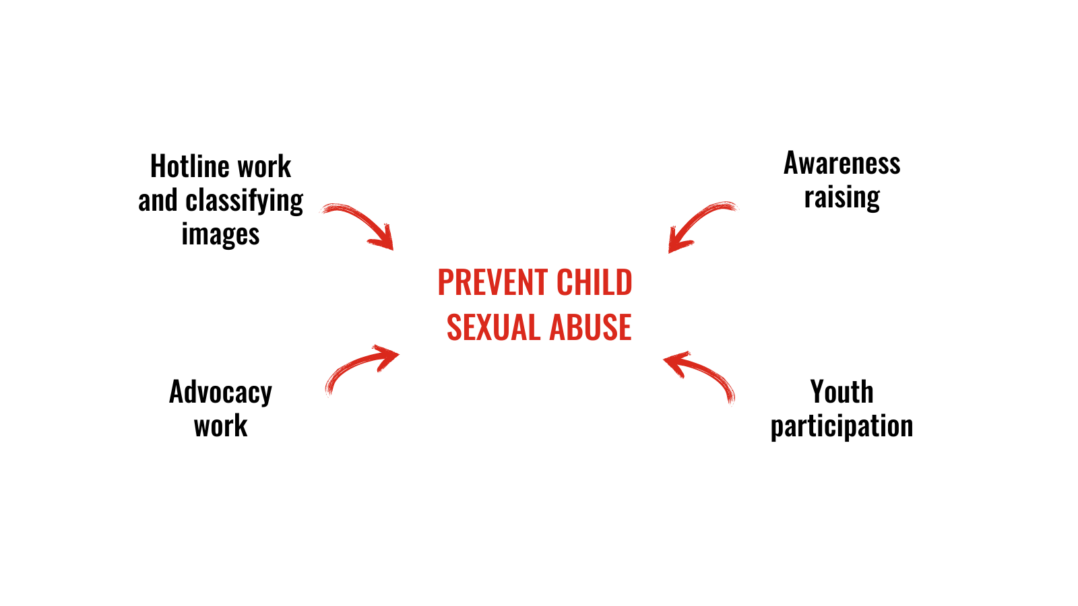
The only hotline in Finland, Nettivihje, is Save the Children Finland’s service through which anyone can submit a report if they suspect that they have come across child sexual abuse material or child sexual abuse.
Our aim is to promote the rapid removal of child sexual abuse material from the web and to prevent children and young people from becoming victims of sexual abuse.
For example the following may be reported to us:
You don’t need to be sure. Don’t hesitate to report it!
Members of the INHOPE network, like Nettivihje, process the reports they receive and pass information on to each other. After this, information about illegal material is passed on to Finnish National Bureau of Investigation and Interpol. Internet service providers will also be notified of the illegal activity to remove the material.
Each time child sexual abuse material is spread online, a child is revictimised. Just the fear that a video or a photograph depicting sexual violence toward oneself might be spread makes it difficult to recover from a sexual crime.
We analyse child sexual abuse materials also as part of Project Arachnid, run by the Canadian Centre for Child Protection. Project Arachnid is a tool to speed up the removal of child sexual abuse material (CSAM) from the internet. Project Arachnid uses both hashing technology and trained experts to detect and remove CSAM from the internet.
Through the provision of knowledge and training, we raise awareness of child sexual abuse, especially in digital environments.
Who are our trainings for?
What topics do we train on?
For example
How can you get training?
You will find the contact information of all of our advisors for training requests at the bottom of this page.
We promote children’s right to be protected from sexual abuse by carrying out persistent advocacy work. Our objective is to see key changes in terms of protecting children implemented in operating practices and structures, both in Finland and abroad.
We work in collaboration with authorities, decision-makers and professionals to achieve our objectives. We issue statements and white papers on current topics regarding sexual violence against children.
Here you can find statements issued by Save the Children Finland (in Finnish).
EU’s Digital Services Act brought along the opportunity for organizations to act as trusted flaggers. The status is awarded by the Digital Services Coordinator of the Member State of the applicant, which in Finland is Traficom. Nettivihje has been a trusted flagger since June 2024.
The Digital Services Act imposes obligations on digital service providers to improve int. al. the safety of their services. Digital service providers are e.g. online forums, social media platforms, and online market places. Digital service providers must process notifications from trusted flaggers as a priority and without delay.
Trusted flaggers must publish an annual report on the activities. The Finnish Hotline’s reports can be found from our Resource Bank in Finnish.





”Kaikki eivät pysty katsomaan pimeyteen. Eikä kaikkien tarvitsekaan. Mutta jos kukaan ei katso, pimeys saa vallan.”
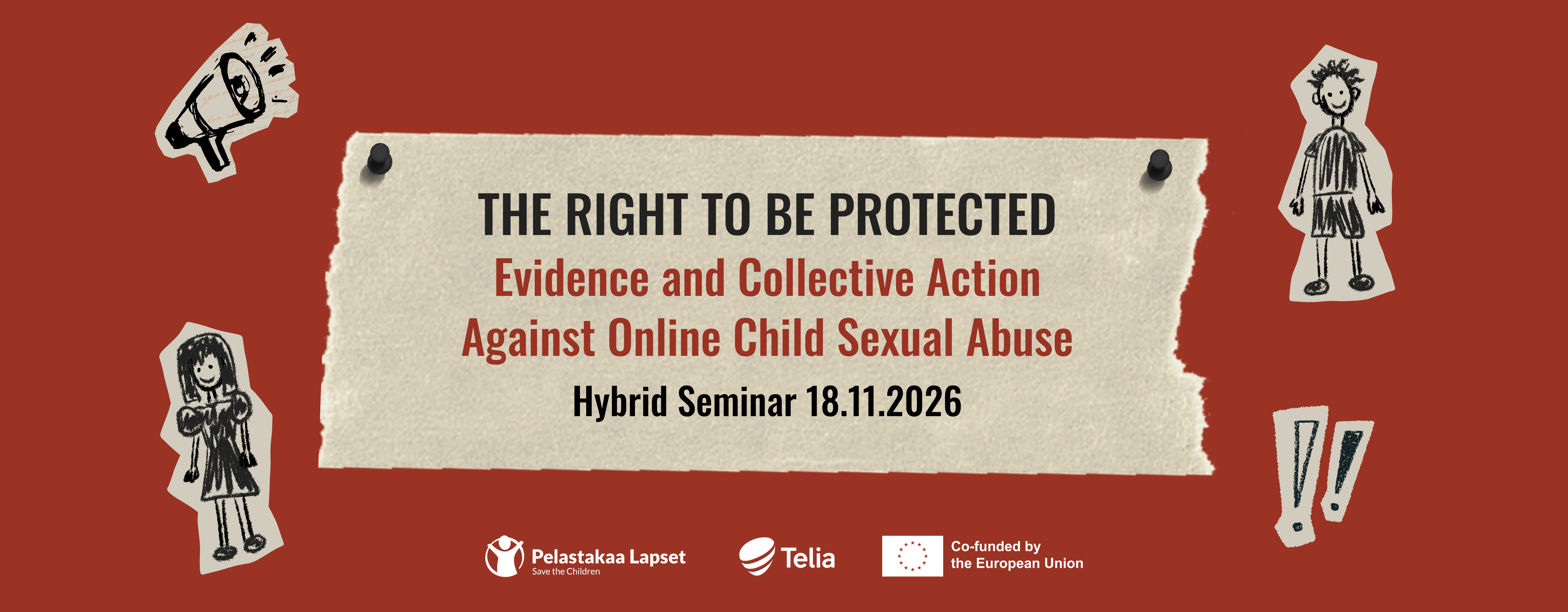
Save the Children Finland, together with its corporate partner Telia, is organizing its annual hybrid seminar on child sexual abuse and prevention on Wednesday, November 18, 2026,…
We are a part of the Finnish Safer Internet Centre (FISIC), which aims to guarantee a better and safer digital environment for children. FISIC work is carried out in cooperation with the Finnish Arts and Culture Agency (KUVI) and the Mannerheim League for Child Welfare. We work together almost daily with the National Bureau of Investigation.
Sexual violence against children and child sexual abuse material are cross-border crimes. We are members and representatives of the international ECPAT and INHOPE networks in Finland.




Funded by the European Union. Views and opinions expressed are however those of the author(s) only and do not necessarily reflect those of the European Union. Neither the European Union nor the granting authority can be held responsible for them.